From Fish to Counter: The Journey of a Single Piece of Nigiri
A piece of nigiri looks simple. Rice, fish, perhaps a brush of soy. What sits in front of you at the counter is the result of a process that begins days earlier, involving decisions most guests never see and would rarely think to ask about.
Receiving and assessing the fish
Not every delivery makes it to the menu. When fish arrives at Sushi Amamoto, it is assessed before anything else: the condition of the flesh, the smell, the colour, the firmness. Quality at this level is not assumed because a supplier is trusted. It is checked every time.
Fish that does not meet the standard is not used which is why the menu changes daily. At a 16-seat counter where a single piece of nigiri is a course in itself, there is no dish to hide behind.
Why fresh does not always mean best
Most people assume the fresher the fish, the better. For sushi, that is not always true.
Certain fish benefits from being aged before service. Bluefin tuna, seabream, turbot: these are rested and aged in-house at Sushi Amamoto for a period of days depending on the species. During that time, the muscle fibres begin to relax. Enzymes break down proteins slowly, developing deeper flavour and a more tender texture. Fish served immediately after catch can be firm to the point of toughness, with little of the complexity that ageing brings out.
It is a process that requires control and judgement. The kitchen is looking for a specific result, not simply waiting. Ageing done poorly produces fish that has deteriorated. Ageing done well produces something noticeably different from what most people expect sushi to taste like.
Breaking down the fish
Once ready, the fish is broken down into the blocks used for service. This stage involves more decisions than it appears to.
The angle of each cut matters. The direction of the muscle fibres, the thickness of the slice, the part of the fish being used: all of these affect how the final piece sits on the rice, how it looks, and critically, how it eats. A cut made at the wrong angle produces a piece that is chewier than it should be, even from the same fish. Knife work at this level is not about speed. It is about consistency and precision, repeated across every piece of every service.
The shari
The rice is made and used within a precise window. Temperature, seasoning, and timing are closely controlled. This alone is the subject of several posts on this blog, so it will not be repeated in detail here, but it is worth noting that the rice is never incidental. It is half the dish.
Forming the nigiri
When the rice and fish are both ready, the nigiri is formed by hand. The pressure applied, the number of folds, the shape of the final piece: these are the result of years of training and repetition. There is no single correct way to form nigiri, and two skilled chefs will do it differently. What matters is the result: a piece that holds together, sits correctly, and delivers rice and fish in the right ratio in a single bite.
Hand temperature, pressure, and timing all play a role. It is a skill that takes years to develop and is difficult to describe accurately from the outside, which is part of why watching it at the counter is worthwhile.
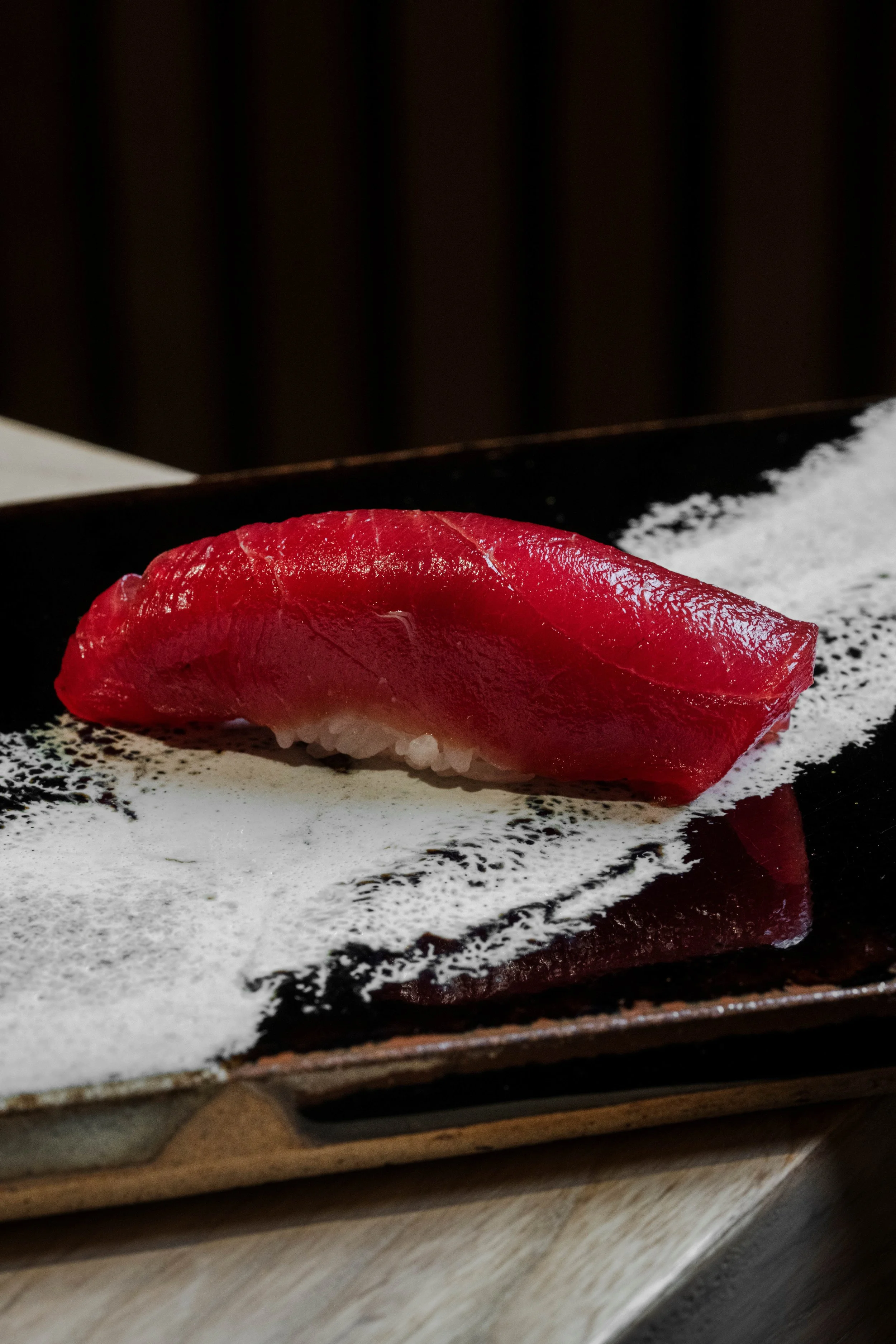
Tuna (akami) - Nigiri
The moment it reaches you
Nigiri is made to be eaten immediately. From the moment it is placed in front of you, it begins to change. The rice starts to cool, the fish shifts slightly in texture, the balance between the two starts to move. Thirty seconds is not an exaggeration.
Everything in the process, the ageing, the knife work, the rice, the forming, leads to that single bite. At a counter like Sushi Amamoto, where each piece is handed to the guest directly by the chef who made it, that moment is the point of the whole thing.
Book your seat at Sushi Amamoto and experience the 16-seat counter in Mayfair.